
Residential excavation
Residential Excavation for Additions, Yards, and Drainage
Residential excavation around the homes people live in: additions next to the house, backyard excavation, lot clearing, and drainage work, planned to protect the house, the yard, and the neighbors across Central Massachusetts, MetroWest, and Greater Boston.
- Free Estimates, No Obligation
- Insured
- Registered Massachusetts Corporation
- 4+ Years of Excavation Experience
- References Available
The scope
What Our Residential Excavation Includes
Residential excavation is digging on a property where a family lives, often a few feet from the house, the driveway, and the neighbors. The work is the same as on any job site, but the margin for error is smaller, so we plan access, protect what is already there, and keep the site tidy every day.
- Excavation for home additions, garages, and accessory buildings
- Backyard excavation for outdoor living areas and patios
- Residential lot clearing before construction or grading
- Drainage trenches and drainage preparation around the house
- Backfill, grading, and cleanup when the digging is done
Most residential projects combine several services. An addition starts with foundation excavation, a wet yard leads to drainage solutions, a wet basement may need basement waterproofing, and a new outdoor space usually ends with a patio base. One crew plans all of it together.
Five kinds of work
Residential Excavation Services for Homeowners
Homeowners call us for very different reasons: more space, a usable backyard, a basement that takes on water, or a new lot that has to be ready for the builder. These five kinds of work make up our residential excavation service, and many projects use two or three of them at the same time.
- 01
Home Site Preparation
Access, work areas, and a stripped, stable surface before construction starts.
- 02
Excavation for Additions
Digging new footings and foundations right next to the existing house.
- 03
Backyard Excavation
Reshaping the yard and preparing areas for patios and outdoor living.
- 04
Residential Lot Clearing
Removing brush, trees, and debris that are in the way of the project.
- 05
Drainage Preparation
Trenches and grading that move water away from the house and yard.
Working close
Digging Next to a House You Live In
Excavating beside an existing home takes more care than digging in an open lot. The old foundation, the utility lines coming into the house, the bulkhead, the deck footings, and the neighbors' property line are all within reach of the bucket, and each of them has to be found and protected before the dig begins.
- Utility markings through Dig Safe, plus private lines you tell us about
- Careful digging along the existing foundation, by hand where needed
- A clear access path that protects the lawn and the driveway
- Excavated soil stored where it will not wash onto your neighbors
- An open excavation kept safe at the end of each day
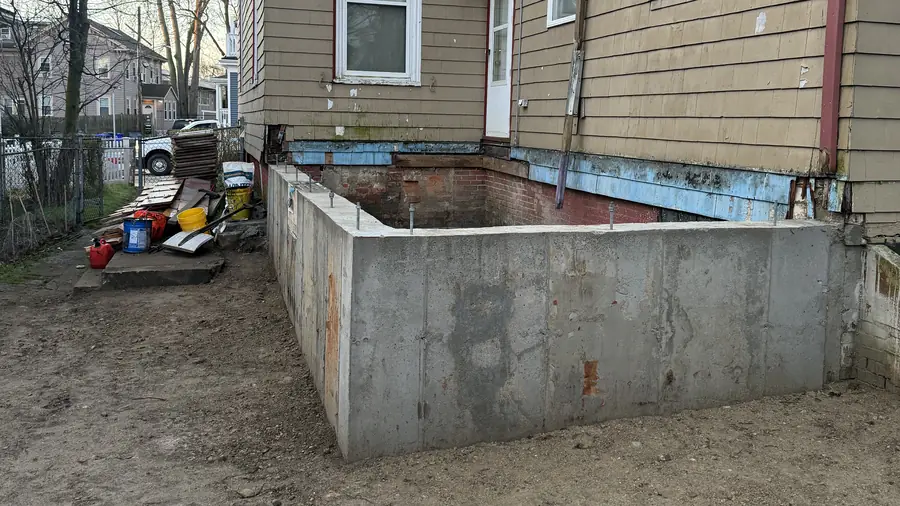
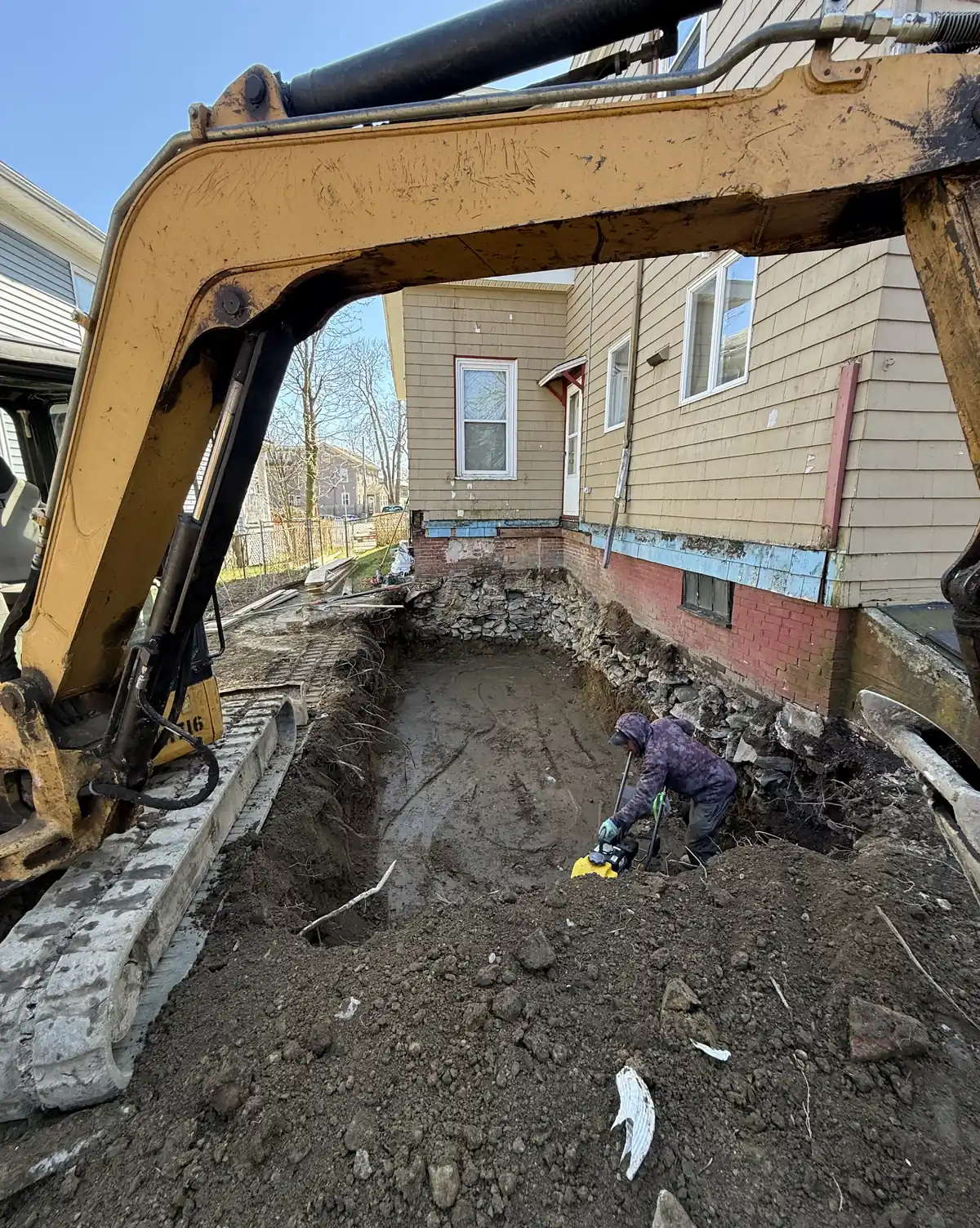
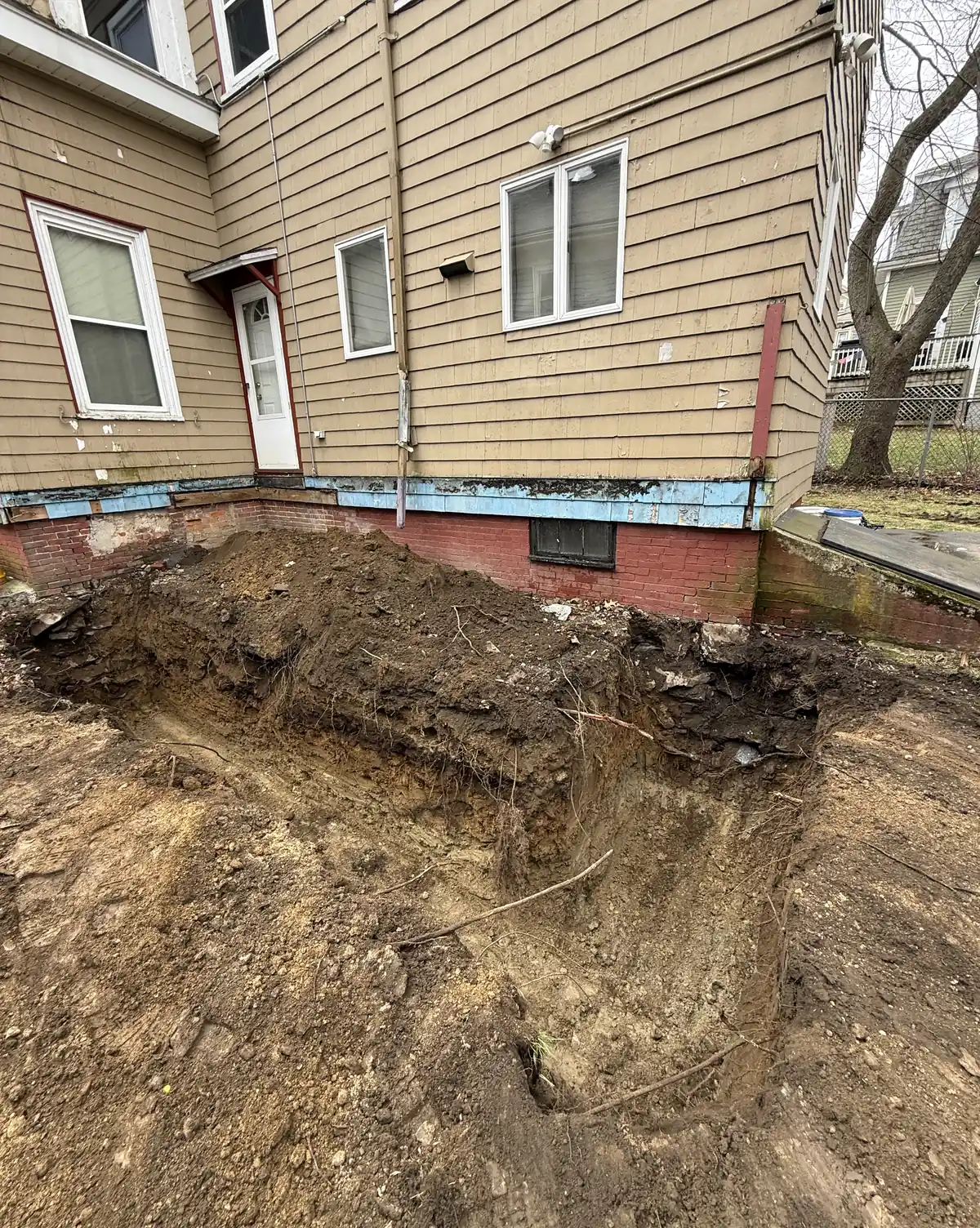
Our photos show this kind of work: an excavator opening an addition hole beside a house with tan siding, the open trench along the back wall, and the finished addition foundation tied to the house. The same care applies to garages, mudrooms, and bump-outs.
Our process
How a Residential Excavation Project Runs
On a residential job, the house stays in use while we work, so the schedule and the site have to make sense for the people living there. We agree on access, parking for equipment, and where materials go before we start, and we keep you updated as each stage is finished.
- 1
Property Visit
We look at the house, access, utilities, grades, and where water goes on the lot.
- 2
Written Scope
You receive an estimate with the excavation, materials, and what leaves the site.
- 3
Excavation
We dig, protect the house and yard, and keep the work area organized.
- 4
Restore the Site
We backfill, grade, and clean up so the yard is ready for the next step.
Local conditions
Older Homes and Tight Lots in Massachusetts
Many neighborhoods in our service area have older homes on small lots, with fieldstone or block foundations, narrow side yards, and mature trees close to the house. Newer subdivisions bring the opposite: larger wooded lots, slopes, and soil full of stones. Both change how a residential excavation is planned and how equipment reaches the work.
On a tight lot, the size of the machine, the route in, and where the soil can be piled are decided before the first day. On a sloped or wet lot, the plan includes where the water will go once the ground is opened, because a trench left open in a heavy rain can fill quickly. If the yard already has a water problem, it is usually best to solve it while the ground is open, with yard or foundation drainage as part of the same project.
Site care
Protecting Your Home, Yard, and Neighbors During the Work
A residential excavation affects more than the hole itself. Equipment crosses the lawn, soil is stockpiled for days, and a rainstorm can move mud where nobody wants it. Planning these details at the start is what separates a job that ends with a clean yard from one that leaves repairs behind.
- A single access route agreed on before equipment arrives
- Stockpiles placed away from neighbors, drains, and the street
- Silt fence or other erosion control where the slope calls for it
- Trees and plantings outside the work area marked and avoided
- The street and driveway kept clear of mud at the end of each day
We go over these points with you during the estimate and write the important ones into the scope. If the town, a conservation commission, or a homeowners association has its own requirements for the project, tell us early, and we will plan the site around them from the first day.
Before we start
Planning a Residential Project With Your Builder
Many homeowners hire us directly, and many hear about us through the builder or general contractor running their addition. Either way, the excavation has to match the plans and the schedule of everyone else on the job. A short conversation with all parties before the dig keeps the project moving and avoids surprises.
- Approved plans and the building permit, when the project needs one
- Where the addition or structure sits, and its finished floor height
- Dates for the concrete crew and the framer after the excavation
- Trees, fences, or structures that stay and must be protected
- What happens to the excavated soil and the existing lawn
Imperial Excavations and Constructions Corp is a registered Massachusetts corporation and carries general liability insurance and workers' compensation coverage. A certificate of insurance is available on request, and so are references from past customers, so you can check both before any equipment reaches the property.
Where we work
Residential Excavation in 88 Massachusetts Towns
We offer residential excavation in eighty-eight towns and cities across Central Massachusetts, MetroWest, and Greater Boston, in Worcester, Middlesex, and Norfolk Counties, working out of our base in Milford. We work on older homes on small lots near town centers and on newer homes on wooded lots in the suburbs.
- Acton
- Ashburnham
- Ashland
- Athol
- Auburn
- Avon
- Barre
- Bedford
- Bellingham
- Berlin
- Boylston
- Braintree
- Brookfield
- Brookline
- Canton
- Charlton
- Clinton
- Cohasset
- Dedham
- Douglas
- Dover
- Dudley
- East Brookfield
- Fitchburg
- Foxborough
- Framingham
- Franklin
- Gardner
- Grafton
- Harvard
- Holbrook
- Holden
- Holliston
- Hopedale
- Hopkinton
- Hubbardston
- Hudson
- Lancaster
- Leicester
- Leominster
- Lowell
- Lunenburg
- Medfield
- Medway
- Mendon
- Milford
- Millbury
- Millis
- Milton
- Natick
- Needham
- New Braintree
- Norfolk
- North Brookfield
- Northborough
- Northbridge
- Norwood
- Oakham
- Oxford
- Paxton
- Plainville
- Princeton
- Quincy
- Randolph
- Rutland
- Sharon
- Shrewsbury
- Southborough
- Southbridge
- Spencer
- Sterling
- Stoughton
- Sturbridge
- Sutton
- Uxbridge
- Waltham
- Warren
- Webster
- Wellesley
- West Boylston
- West Brookfield
- Westborough
- Westminster
- Westwood
- Weymouth
- Winchendon
- Worcester
- Wrentham
Free estimate
Get a Free Residential Excavation Estimate
Tell us about the addition, backyard, or drainage project you are planning, even if the details are not final yet. We will visit the property, look at the house, access, and drainage, and send a written estimate with the scope of work, with no cost and no obligation to hire us.
- Free Estimates, No Obligation
- Insured
- Registered Massachusetts Corporation
- 4+ Years of Excavation Experience
- References Available
Prefer to talk? Call (508) 500-6598
FAQ
Residential Excavation Questions and Answers
These are the questions property owners and builders ask most often about residential excavation before they hire an excavation contractor in Central Massachusetts: additions, backyards, drainage, lawns, neighbors, and cost. If your question is not listed here, send it with your estimate request and we will answer it before any work is scheduled.
What is residential excavation?
Residential excavation is excavation work on a home or a residential lot. It covers digging for additions and garages, backyard excavation, lot clearing, drainage trenches, and the backfill and grading that follow. The difference from other excavation is the setting: the work happens close to a house that people live in, so access and protection are planned carefully.
Do I need excavation before building a home addition?
In most cases, yes. An addition needs footings and a foundation, and those have to be dug to the depth on the plans and sit on firm ground. We excavate along the existing house, protect its foundation and utilities, and prepare the bottom for the new footings, so the concrete crew can form and pour the addition foundation.
Will the excavation damage my lawn and driveway?
Equipment and excavated soil do affect the area they cross, so we plan the access path with you before the job starts and keep it as narrow as the work allows. When the digging is finished, we backfill and grade the disturbed area. Final lawn work, such as loam and seed, can be discussed during the estimate.
Can you work on a small lot with tight access?
Many of our residential jobs are on small lots with narrow side yards and houses close together, as our photos show. We look at access during the site visit, choose an approach that fits the space, and plan where the soil will go. If a lot is too tight for a safe approach, we tell you during the estimate.
Can residential excavation fix a wet yard or basement?
Excavation is often part of the fix. Water problems usually come from grading that sends water toward the house or from ground that cannot drain. We can grade the yard, dig trenches for French drains or yard drainage, and excavate along the foundation for foundation drainage. Our drainage solutions page explains each option in more detail.
Is lot clearing part of residential excavation?
It can be. If brush, trees, or debris are in the way of an addition, a new home, or a backyard project, residential lot clearing comes first so equipment can reach the work area. Our land clearing service covers this in more detail, and we can schedule the clearing and the excavation as one job.
Do you work with my builder or general contractor?
Yes. Many residential projects are run by a builder or general contractor, and we handle the excavation as part of their schedule. We follow the approved plans and elevations, coordinate the timing with the concrete crew, and leave the site ready for the next trade. Homeowners can also hire us directly for excavation and site work.
Do you call Dig Safe before digging on my property?
Massachusetts law requires a Dig Safe request before excavation, so the utility companies can mark their underground lines. Those marks are confirmed on site before we dig. Private lines, such as a septic pipe, a sprinkler system, or wiring to a shed or a lamp post, are not marked by the utilities, so we ask you about them first.
How long does residential excavation take?
It depends on the type of project, the size of the dig, the soil and rock we find, access, and the weather. Excavation for a small addition is a short job, while a new home with a full basement and drainage takes longer. The estimate includes a realistic schedule, and we keep you updated as each stage is finished.
How much does residential excavation cost?
The price depends on the size and depth of the work, access to the area, the soil and rock, how much material has to be hauled away or brought in, and the drainage the property needs. We visit the property, measure, and talk through the project, then send a free estimate that lists the work, with no obligation.