
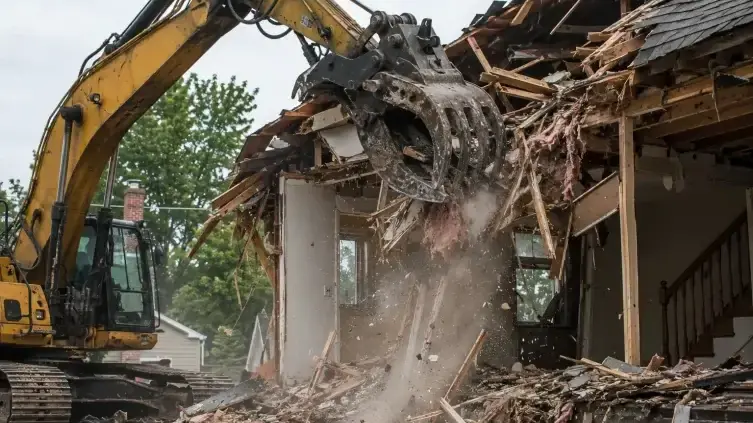
Demolition
Demolition Services for Homes, Garages, and Concrete
Demolition services that take down what is in the way, from a garage or an outbuilding to old concrete and residential structures, and leave a clear site ready for what comes next, across Central Massachusetts, MetroWest, and Greater Boston.
- Free Estimates, No Obligation
- Insured
- Registered Massachusetts Corporation
- 4+ Years of Excavation Experience
- References Available
The scope
What Our Demolition Services Include
Demolition is often the first step of a bigger project: a new home on the lot of an old one, an addition where a garage used to be, or a new patio where cracked concrete stands today. Our demolition services cover taking the structure down, removing the debris, and preparing the ground for the next stage.
- Residential demolition of houses and parts of houses
- Garage, shed, and outbuilding demolition
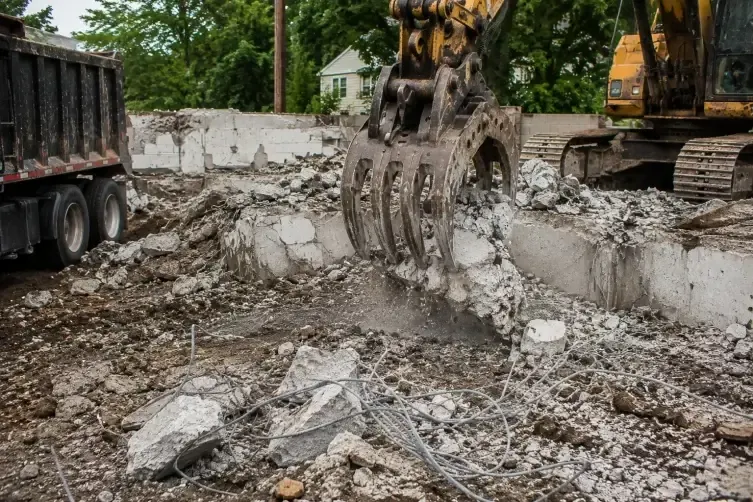
- Concrete removal: slabs, walkways, patios, and old foundations
- Structure removal and loading of debris for disposal
- Site clearing and rough grading after demolition
Because we are an excavation contractor, demolition does not stop at the surface. Old foundations and slabs can be removed and the hole backfilled, or the site can move straight into land clearing and foundation excavation for the new structure.
Five kinds of demolition
Demolition Services We Provide
Demolition projects range from a single slab of concrete to a whole structure. Each one has its own planning, safety, and cleanup needs. These are the five services that make up our demolition work. Most jobs combine the demolition itself with concrete removal and the cleanup that leaves the site ready for building.
- 01
Residential Demolition
Houses and parts of houses taken down safely and in a planned order.
- 02
Concrete Removal
Old slabs, walkways, patios, steps, and foundations broken out and removed.
- 03
Structure Removal
Decks, porches, sheds, and other structures removed from the property.
- 04
Garage Demolition
Detached garages taken down, including the slab when the project needs it.
- 05
Site Clearing After Demolition
Debris removed and the ground left clear, safe, and ready.
Common projects
When a Project Starts With Demolition
Most demolition is not about tearing something down for its own sake. It makes room for a better use of the property. These are the projects that most often bring homeowners, builders, and property owners to us for demolition, usually as the first phase of a larger excavation and construction job on the same site.
- An old house removed to build a new home on the lot
- A detached garage replaced by a larger garage or an addition
- A cracked concrete patio or walkway replaced with a new one
- An old foundation or slab removed before new construction
- A deteriorated shed, deck, or outbuilding taken off the property
If the next step is a new patio, our patio excavation page explains how the base is prepared. If the next step is a new structure, demolition flows straight into excavation, so the site is never left half-finished between contractors.
Our process
How a Demolition Project Runs
A safe demolition is planned before anything comes down. We look at the structure, what is around it, and the utilities connected to it, agree on what stays and what goes, and plan the order of the work. Then we take it down, remove the debris, and leave the ground ready for the next phase.
- 1
Assessment
We look at the structure, nearby buildings, access, and the utility connections.
- 2
Preparation
Utilities are confirmed disconnected and the work area is secured.
- 3
Demolition
The structure and any concrete come down in a planned order.
- 4
Cleanup
Debris is removed and the site is cleared and rough graded.
Before anything comes down
Permits, Utilities, and Safety Before Demolition
In Massachusetts, demolishing a building usually needs a permit from the local building department, and utilities such as electric, gas, water, and sewer have to be disconnected by the right parties before work starts. Some towns also review older buildings before they can be torn down, so checking early saves time.
Older structures can contain materials that need special handling before demolition, such as asbestos in old siding, floor tile, or pipe insulation. Those materials have to be identified and dealt with by qualified people before the structure comes down. We go over these questions during the site visit, so the permit, the disconnections, and any testing are planned into the schedule instead of discovered on demolition day.
On the day of the work, safety means a secured work area, a planned order of demolition, and protection for nearby buildings, trees, and neighbors.
The finished site
What Is Left After a Demolition Job
A demolition is only finished when the ground is ready for whatever comes next. Leaving broken concrete, buried debris, or an open hole behind turns a simple demolition into a problem for the next contractor. Agreeing on the condition of the site at the end is one of the most important parts of the estimate.
- Debris removed from the property, not buried on site
- Old slabs and footings removed where the new plan requires it
- Holes from foundations or tanks backfilled and compacted
- The area rough graded so water does not pool
- Driveways and lawns crossed by equipment left in usable condition
If a new structure or a patio follows the demolition, we can move straight into the foundation excavation or the patio base, so the ground is only disturbed once. If the lot will sit empty for a while, it can be graded and stabilized so it does not erode while you plan the next step.
Before we start
Planning Your Demolition Project
A demolition estimate depends on what is being removed and what comes after it. A garage that will be replaced by an addition needs a different finish than a lot that will sit empty for a while. These are the points we go over with you before the estimate, so the scope matches the plan for the property.
- What is being demolished, and whether the slab or foundation goes too
- What stays: nearby buildings, trees, fences, and driveways
- Utility connections and who disconnects each one
- Permits and any review the town requires
- What comes next: a new structure, a patio, or a graded lot
Imperial Excavations and Constructions Corp is a registered Massachusetts corporation and carries general liability insurance and workers' compensation coverage. A certificate of insurance is available on request, and so are references from past customers, so you can check both before any equipment reaches the property.
Where we work
Demolition Services in 88 Massachusetts Towns
We offer demolition services in eighty-eight towns and cities across Central Massachusetts, MetroWest, and Greater Boston, in Worcester, Middlesex, and Norfolk Counties, working out of our base in Milford. Many projects in the region start with an old garage, a worn-out slab, or a structure that no longer fits the property.
- Acton
- Ashburnham
- Ashland
- Athol
- Auburn
- Avon
- Barre
- Bedford
- Bellingham
- Berlin
- Boylston
- Braintree
- Brookfield
- Brookline
- Canton
- Charlton
- Clinton
- Cohasset
- Dedham
- Douglas
- Dover
- Dudley
- East Brookfield
- Fitchburg
- Foxborough
- Framingham
- Franklin
- Gardner
- Grafton
- Harvard
- Holbrook
- Holden
- Holliston
- Hopedale
- Hopkinton
- Hubbardston
- Hudson
- Lancaster
- Leicester
- Leominster
- Lowell
- Lunenburg
- Medfield
- Medway
- Mendon
- Milford
- Millbury
- Millis
- Milton
- Natick
- Needham
- New Braintree
- Norfolk
- North Brookfield
- Northborough
- Northbridge
- Norwood
- Oakham
- Oxford
- Paxton
- Plainville
- Princeton
- Quincy
- Randolph
- Rutland
- Sharon
- Shrewsbury
- Southborough
- Southbridge
- Spencer
- Sterling
- Stoughton
- Sturbridge
- Sutton
- Uxbridge
- Waltham
- Warren
- Webster
- Wellesley
- West Boylston
- West Brookfield
- Westborough
- Westminster
- Westwood
- Weymouth
- Winchendon
- Worcester
- Wrentham
Free estimate
Get a Free Demolition Estimate
Tell us what you want removed and what you plan to do with the space afterward. We will look at the structure, access, and what is around it, and send a written estimate with the scope of the demolition and the cleanup, with no cost and no obligation to hire us.
- Free Estimates, No Obligation
- Insured
- Registered Massachusetts Corporation
- 4+ Years of Excavation Experience
- References Available
Prefer to talk? Call (508) 500-6598
FAQ
Demolition Services Questions and Answers
These are the questions property owners and builders ask most often about demolition services before they hire an excavation contractor in Central Massachusetts: what we remove, permits, utilities, debris, timing, and cost. If your question is not listed here, send it with your estimate request and we will answer it before any work is scheduled.
What demolition services do you offer?
Our demolition services include residential demolition, concrete removal, structure removal, garage demolition, and site clearing after demolition. That covers houses and parts of houses, detached garages, sheds, decks, porches, old slabs, walkways, patios, and foundations. After the demolition, we remove the debris and leave the ground clear and ready for the next phase of the project.
Do you remove the foundation or slab too?
It depends on what comes next. If a new structure will be built, the old foundation or slab usually has to come out so the new one can be excavated properly. If the lot will become lawn or a patio, the slab is removed and the area backfilled and graded. The estimate states what is removed and how the ground is left.
Do I need a permit for demolition in Massachusetts?
Demolishing a building usually needs a permit from the local building department, and requirements vary by town. Some towns also review older buildings before demolition. Smaller jobs, such as removing a concrete walkway, may not need one. We go over this during the site visit, and we recommend confirming the requirements with your town early in the planning.
Who disconnects the utilities before demolition?
Electric, gas, water, and sewer connections have to be shut off and disconnected by the utility companies or qualified trades before a structure comes down. That has to be confirmed before demolition starts, for safety and to meet the permit requirements. We review the connections with you during the site visit so the disconnections are scheduled in time.
What about asbestos or other hazardous materials?
Older buildings can contain asbestos or other materials that must be identified and removed by qualified professionals before demolition. We do not remove those materials ourselves. If the structure is old enough to raise the question, testing should be arranged first, and the demolition is scheduled after any required abatement is completed and documented.
Can you remove concrete without demolishing a building?
Yes. Concrete removal is one of our most common demolition jobs: old patios, cracked walkways, slabs, steps, and pads. We break out the concrete, load and remove it, and leave the area ready for whatever comes next, whether that is a new patio base, a garage foundation, or loam and seed.
What happens to the debris?
Debris from the demolition is loaded and hauled away for disposal or recycling, depending on the material. Concrete, wood, and metal are handled differently, and some material can be separated for recycling. The estimate states what is removed from the property and how the site will be left when the job is finished.
Can demolition and the new construction be done by the same team?
Yes, and it saves time. After the structure is down, the same crew can remove the old foundation, prepare the site, and dig the new foundation or patio base, so there is no gap between contractors. Our land clearing and foundation excavation pages explain those next steps in more detail.
How long does a demolition project take?
It depends on the size and type of structure, whether the slab or foundation is removed, access, the amount of debris, and the time needed for permits and utility disconnections. Removing a concrete walkway is a short job, while a house takes longer. The estimate includes a realistic schedule once the preparation steps are known.
How much do demolition services cost?
The cost depends on what is being demolished, its size and materials, whether the slab or foundation is removed, access for equipment, and the amount of debris to haul away. We look at the structure and the site in person, then send a free, no-obligation estimate with the scope of the demolition and the cleanup.